
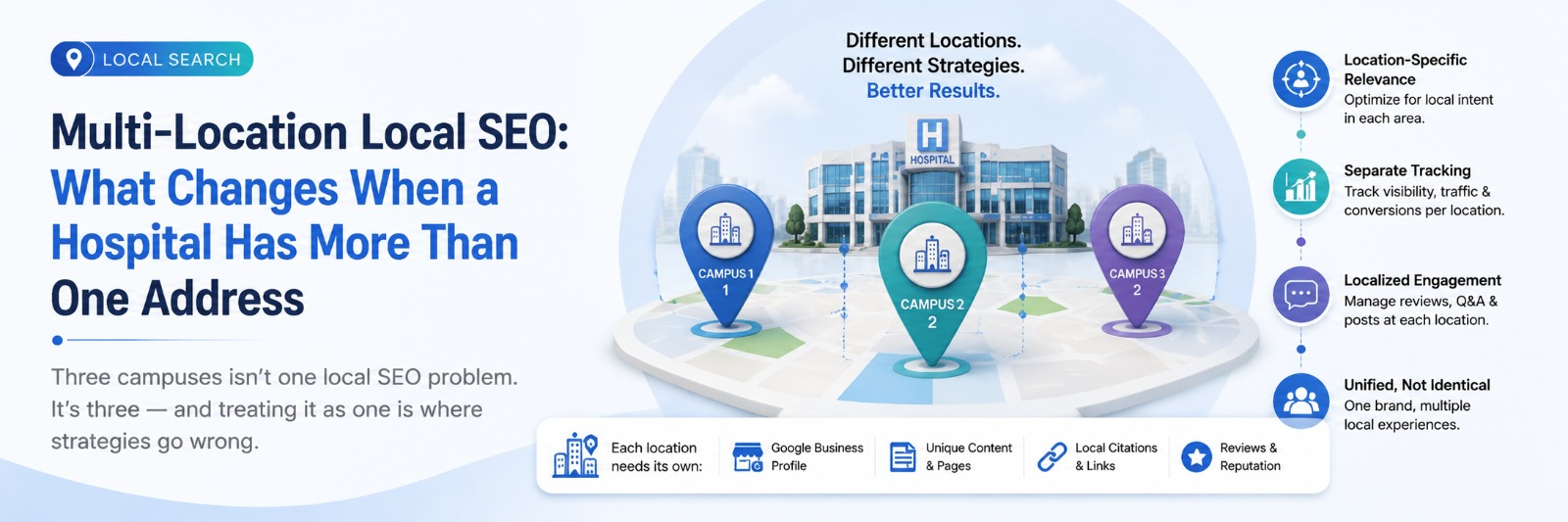
A hospital system with three campuses doesn't have one local SEO problem — it has three, and treating them as one is where most multi-location strategies go wrong.
Every physical location needs its own profile
One Google Business Profile trying to represent multiple addresses is a structural mistake, not a shortcut. Each location needs its own listing, its own unique local phone number, and its own address — consolidating them confuses the algorithm and the patient in exactly the same way.
Duplicate content across location pages hurts more than it helps
Copying one location page and swapping the address is a common shortcut that actively undermines rankings. Each location page needs genuinely distinct content — the specific doctors, services, and details relevant to that specific site — not a template with find-and-replace.
Reviews need to be managed per location, not in aggregate
A hospital system with a strong overall reputation can still have one underperforming location dragging down inquiries specifically for that site, invisible in company-wide review averages. Review generation and response need to happen at the location level to actually move each location's individual ranking.
Cannibalization is a real risk, not a theoretical one
Two nearby locations targeting identical keywords can end up competing against each other in search results instead of the intended competitor. Location-specific keyword strategy has to account for genuine proximity between a hospital system's own campuses, not just the competition outside it.
A practical starting checklist
- One profile per physical location, each with unique, accurate NAP data.
- Distinct page content per location — not a template with the address swapped.
- Location-level review tracking and response, not just a company-wide dashboard.
- A keyword map that accounts for proximity between your own locations, not just outside competitors.
Multi-location local SEO isn't a bigger version of single-location local SEO. It's a genuinely different structural problem, and most of the mistakes come from treating it like the same one, just scaled up.