
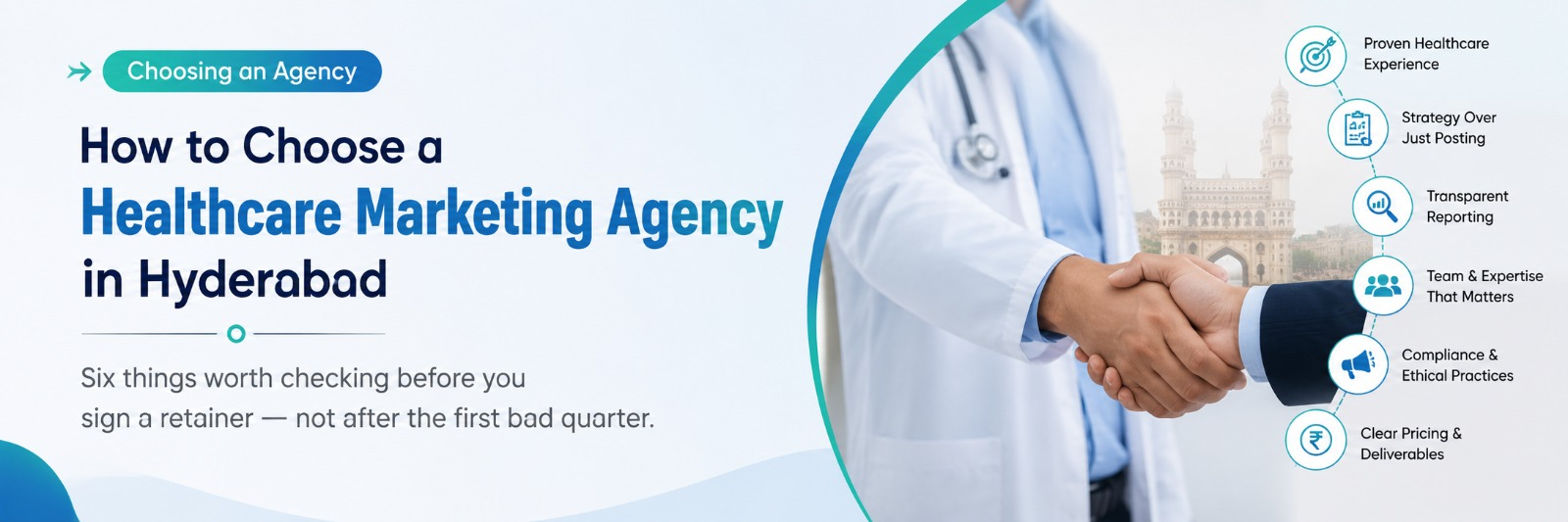
Most hospitals and clinics don't set out to hire the wrong agency. They set out to hire quickly, usually after a bad quarter, and end up picking whoever made the most confident pitch. Confidence isn't the thing to screen for. Here's what actually is.
Start with healthcare-specific experience, not a generalist portfolio
A portfolio full of restaurants, real estate, and e-commerce brands tells you an agency can run ads. It doesn't tell you they understand how a patient actually decides between two hospitals, why physician referral relationships matter more than click-through rate, or what the Indian Medical Council's advertising restrictions mean for your ad copy. Ask directly: what percentage of your current clients are healthcare, and how long have you worked exclusively in this category? A generalist agency can still do competent work. It just won't have the instincts a specialist has already built.
Ask how they handle timelines — before you sign, not after
Paid campaigns can show activity within weeks. Local search and organic SEO realistically take a few months to build and hold a position. Any agency that promises fast organic rankings, or doesn't distinguish between the two, is either inexperienced or being deliberately optimistic to close the deal. Ask them to walk you through what happens in month one, month three, and month six — separately. A vague answer here is the clearest early warning sign there is.
Understand the pricing model before you sign anything
Healthcare marketing pricing generally falls into a few shapes: a flat monthly retainer, a retainer plus a performance component tied to leads or ad spend, or a project fee for a one-time build like a website. None of these is inherently better — but a fixed tiered package sold the same way to a solo clinic and a multi-department hospital is usually a sign the agency hasn't actually scoped your specific situation. Ask what the number is based on, not just what the number is.
Check their grasp of medical advertising compliance
Healthcare advertising in India operates under real restrictions on the claims a provider can make. An agency that doesn't bring this up unprompted, or treats it as an afterthought, is a liability — not because of ill intent, but because non-compliant ad copy gets accounts suspended on Google and Meta with little warning. This should come up in the first conversation, not after your first campaign gets flagged.
Ask about lead qualification, not just lead volume
A hundred leads a month sounds better than thirty. It usually isn't, if ninety of them were never going to book an appointment. Ask how the agency defines a qualified lead for your specific procedures or services, and how that gets tracked over time — not just how many form fills a campaign generated.
Find out how they defend a ranking, not just win it once
Local search, especially in a competitive city, doesn't stay won. A position earned this month can slide within a quarter without ongoing attention. Ask what happens after page one is reached — if the answer is "we move on to the next project," that's worth knowing before you sign a long-term retainer.
A short checklist before you decide
- Do they work exclusively, or primarily, in healthcare?
- Can they explain their pricing logic, not just quote a number?
- Do they bring up compliance before you have to ask?
- Do they talk about qualified leads, or just lead volume?
- Do they have a plan for defending rankings, not just reaching them?
- Are their timelines specific to your situation, or generic promises?
None of this guarantees a good outcome on its own. But an agency that can answer all six without hesitation is telling you something real about how they actually work — not just how they pitch.